Saturday, January 14, 2012

Osteoarthritis: Diagnosis and Treatment


Osteoarthritis is a common degenerative disorder of the articular cartilage associated with hypertrophie bone changes. Risk factors include genetics, female sex, past trauma, advancing age, and obesity. The diagnosis is based on a history of joint pain worsened by movement, which can lead to disability in activities of daily living. Plain radiography may help in the diagnosis, but laboratory testing usually does not. Pharmacologic treatment should begin with acetaminophen and step up to nonsteroidal anti-inflammatory drugs. Exercise is a useful adjunct to treatment and has been shown to reduce pain and disability. The supplements glucosamine and chondroitin can be used for moderate to severe osteoarthritis when taken in combination. Corticosteroid injections provide inexpensive, short-term (four to eight weeks) relief of osteoarthritic flare-ups of the knee, whereas hyaluronic acid injections are more expensive but can maintain symptom improvement for longer periods. Total joint replacement of the hip, knee, or shoulder is recommended for patients with chronic pain and disability despite maximal medical therapy


- Signs and Symptoms of Osteoarthritis

    Hand
    Pain on range of motion
    Hypertrophic changes at distal and proximal interphalangeal joints (Heberden nodes and Bouchard nodes; Figure 1)
    Tenderness over metacarpophalangeal joint of thumb 
    Shoulder
    Pain on range of motion
    Limitation of range of motion, especially external rotation
    Crepitus on range of motion
    Knee
    Pain on range of motion
    Joint effusion
    Crepitus on range of motion
    Presence of popliteal cyst (Baker cyst)
    Lateral instability
    Valgus or varus deformity
    Hip
    Pain on range of motion
    Pain in buttock
    Limitation of range of motion, especially internal rotation
    Foot
    Pain on ambulation, especially at first metatarsophalangeal joint
    Limited range of motion of first metatarsophalangeal joint, hallux rigidus
    Hallux valgus deformity
    Spine
    Pain on range of motion
    Limitation of range of motion
    Lower extremity sensory loss, reflex loss, motor weakness caused by nerve root impingement
    Pseudoclaudication caused by spinal stenosis


SORT: KEY RECOMMENDATIONS FOR PRACTICE
Clinical recommendationEvidence ratingReferences
Physical therapy using land-based or water-based exercise can help reduce pain and improve function in patients with osteoarthritisB[10] , [11] ,[12]
Acetaminophen should be used as first-line therapy for mild osteoarthritis.A16
Nonsteroidal anti-inflammatory drugs are superior to acetaminophen for treating moderate to severe osteoarthritisA16
Intra-articular corticosteroid injections can be beneficial for short-term (i.e., less than eight weeks) relief of osteoarthritis pain of the knee.A[21] , [22]
Compared with intra-articular corticosteroids, intra-articular hyaluronic acid njections of the knee are less effective in the short term, equivalent in the ntermediate term (i.e., four to eight weeks), and superior in the long termB[26] , [27]
The combination of glucosamine and chondroitin may decrease pain in patients with moderate to severe knee osteoarthritis, although the evidence for this effect is limited and inconsistent.B30
Patients who have continued pain and disability from osteoarthritis of the hip, knee, or shoulder despite maximal medical therapy are candidates for total joint replacement.


Complementary and Alternative Medicine

A meta-analysis on the effectiveness of acupuncture for osteoarthritis of the knee found only short-term benefit, which the authors described as clinically irrelevant.[28] Acupuncture can be of benefit in chronic low back pain, but studies do not differentiate the etiology of the back pain.[29]

The most widely used supplements for osteoarthritis are glucosamine and chondroitin. The literature consisted of small clinical trials until the release of the Glucosamine/Chondroitin Arthritis Intervention Trial (GAIT), which included more than 1,500 patients. The trial had five arms comparing glucosamine alone, chondroitin alone, a combination of glucosamine and chondroitin, celecoxib, and placebo. The results were favorable only for the combination of glucosamine and chondroitin, which appeared to be effective for moderate to severe osteoarthritis of the knee.[30] Chondroitin alone did not show benefit for osteoarthritis of the knee or hip in a meta-analysis.[31]

Balneotherapy is a heterogeneous group of treatments also known as spa therapy or mineral baths. A Cochrane review concluded that mineral baths were of some benefit to patients with osteoarthritis, but the authors addressed methodologic flaws in the studies and urged caution in interpreting the findings.[32] Capsaicin cream is a topical analgesic derived from chili peppers. It has been found to be superior to placebo in treating osteoarthritis pain. It is widely available, is relatively inexpensive, and can be used as an adjunct to standard osteoarthritis treatments.[33] There also is evidence supporting the use of the supplement S-adenosylmethionine (SAM-e) to reduce functional limitation, but not compared with placebo in patients with osteoarthritis pain. The effectiveness of SAM-e is comparable to that of NSAIDs in some studies but with fewer adverse effects.[34]
Surgical

Surgery should be reserved for patients whose symptoms have not responded to other treatments. The well-accepted indication for surgery is continued pain and disability despite conservative treatment. The most effective surgical intervention is total joint replacement, with excellent patient outcomes following total joint replacement of the hip, knee, and shoulder. [1] , [35] Many different prosthetic devices are available; however, controlled trials comparing the various devices are lacking. Patients can expect that most current joint prostheses will function well for 15 to 20 years.[35]

There are other surgical approaches to osteoarthritis treatment, but they have not equaled the success of total joint replacement. Randomized trials of arthroscopic debridement for osteoarthritis of the knee have consistently failed to show an advantage over maximal medical therapy combined with physical therapy.[36]


Thursday, January 5, 2012

IBS

Diagnostic Criteria for IBS

Abdominal discomfort or pain, for at least 12 weeks (which need not be consecutive) in the preceding 12 months, with two of the following features:

Relief with defecation

Onset associated with a change in stool frequency

Onset associated with a change in form or appearance of stool

These additional symptoms cumulatively support the diagnosis of IBS:

Abnormal stool frequency (more than three times per day or less than three times per week)
Abnormal stool form (loose and watery or lumpy and hard)
Abnormal stool passage (urgency, frequency, feeling of incomplete evacuation)
Passage of mucus (white material)
Bloating or sensation of abdominal distention

Signs and Symptoms Suggesting Alternative Diagnosis to Irritable Bowel Syndrome


Sign or symptomsSuggested diagnosis
Alarm factors
AnemiaCancer, IBD
Chronic severe diarrheaCancer, infection, IBD
Family history of colon cancerCancer
Hematochezia, melena, or other signs of intestinal bleedingCancer, arteriovenous malformation, colonic polyps, IBD
Recurrent feverInfection, IBD
Weight lossCancer, IBD
Other signs and symptoms
Travel to areas with parasitic diseasesInfection
Family history of colon cancer, irritable bowel syndrome, celiac diseaseCancer, celiac disease
Signs or symptoms of malabsorptionCeliac disease
Nighttime symptoms (e.g., encopresis)Infection, trauma
Onset after 50 years of ageCancer
ArthritisArthritis
Thyroid dysfunction


Medications for Treatment of Irritable Bowel Syndrome

TreatmentInitial dosageMaintenance dosageCost (generic)*Comments
Dicyclomine (Bentyl)20 mg fourtimes per day20 to 40 mg four times per day$63 (22 to 82)If not effective in two weeks, discontinue.
Hyoscyamine (Levsin)0.125 to 0.250 mg every four hoursSame145 (52 to 61)Anticholinergic effects; maximum 1.5 gm per day
Loperamide (Imodium)4 mg4 to 8 mg per day49 (15 to 42)—
Amitriptyline10 to 25 mg every night at bedtime10 to 100 mg every night at bedtime8 (2 to 10)Large dosing range; start low, and titrate as needed.
Desipramine (Norpramin)10 to 50 mg every night at bedtime10 to 150 mg every night at bedtime21 (12 to 21)Large dosing range; start low, and titrate as needed.
Alosetron (Lotronex)1 mg per day for four weeks1 mg once or twice per day216Use in women with diarrheapredominant irritable bowel syndrome; use with caution; available only through prescribing program; associated with ischemic colitis.
Tegaserod (Zelnorm)6 mg twice per day for four to 12 weeksSame169Use in constipation with same caveats as alosetron; only indicated for 12 weeks of therapy.


Monday, December 26, 2011

Dabigatran (Pradaxa)for Prevention of Stroke in Atrial Fibrillation

Dabigatran (Pradaxa)is an orally administered direct thrombin inhibitor labeledfor the prevention of stroke and systemic embolism in patients with nonvalvular atrial fibrillation. Unlikewarfarin (Coumadin), it does not induce anticoagulation through depletion of clotting factors, but through an immediate effect on thrombin, the last step in the coagulation cascade that causes clotformation.


DrugDosageDoseformCost of full course [*]
Dabigatran (Pradaxa)150 mg twice daily; 75 mg twice daily in patients with impaired renal function75- and 150-mg capsules$246for 60 150-mg capsules

<><><>
*    —Estimated retail price of one month's treatment based on information obtained at http://www.blogger.com/website/view?area=be&URL=http://www.drugstore.com (accessed October 25, 2010).


Safety Tolerability Effectiveness Price Simplicity


Dabigatran increases the risk of minor and major bleeding. In a randomized controlled trial ofdabigatran compared with dose-adjustedwarfarin (International Normalized Ratio of 2.0 to 3.0) in more than 18,000 patients with atrial fibrillation, life-threatening bleeding and intracranial hemorrhage occurred less often withdabigatran, with one fewer patient experiencing an intracranial hemorrhagefor every 117 patients treated withdabigatran instead ofwarfarin (number needed to treat [NNT] = 117; 95% confidence interval [CI], 82 to 201).[1]Although gastrointestinal bleeding occurs more often withdabigatran, the incidence of minor bleedingis lower (NNT = 37; 95% CI, 23 to 99).[1]Unlikewarfarin,dabigatran lacks significant drug interactions. However, the concurrent use of antiplatelet agents, heparin, or long-term nonsteroidal anti-inflammatory drugs may increase the risk of bleeding. Thereis no reversal agentfordabigatran. Itis renally eliminated, and the dosage must be reduced in patients with a creatinine clearance of less than 30 mL per minute per 1.73 m2 (0.50 mL per second per m2).[2]Dabigatran has not been studied in children or in pregnant or breastfeeding women. Itis a U.S Food and Drug Administration pregnancy category C drug.


In clinical trials, more patients receivingdabigatran withdrew because of adverse effects compared with those receivingwarfarin.Dabigatran causes dyspepsia and gastritis symptoms in about one-third of patients.


Dabigatran has been compared with enoxaparin (Lovenox) andwarfarin in randomized controlled trials. In a study of 18,000 patients with atrial fibrillation, those who receiveddabigatran had significantly fewerischemic strokes than those who receivedwarfarin for a median of two years (NNT = 91; 95% CI, 59 to 194).[1]Dabigatran has been studiedfor surgery prophylaxis (versus enoxaparin) andfor the treatment of deep venous thrombosis and pulmonary embolism (versuswarfarin), but itis not labeledfor these uses


A one-month supply of 150-mgdabigatran capsules costs approximately $246; a one-month supply of genericwarfarin costs approximately $15.[6]The lack of laboratory monitoring or office visitsfor dose titration may partially offset this difference.


Dabigatran produces an effect on coagulation in 30 to 90 minutes, has a predictable response, does not require routine laboratory monitoring, and does not have the drug and food interactions that can be problematic withwarfarin therapy. Patient compliance with twice-daily dosing must be stressed. The dose ofdabigatran is fixed and does not require titration when therapyis initiated or discontinued.

Bottom Line

Dabigatran is superior towarfarin for stroke prevention in patients with atrial fibrillation, with similar rates of major bleeding. Because it does not require laboratory monitoring,dabigatran therapyis less complicated thanwarfarin therapy, but it costs significantly more

Saturday, December 24, 2011

this case i saw her in my clinic session,she is 9 year old girl with 3 days history of painful lesions over back
what do u think?
see the question upper right of the screen


Tuesday, December 20, 2011

What do u think?

This case i saw her last week ,she is 24 years old with 2 years history of nail disease
what do you think?

Hyperthyroidism

Common Etiology and Clinical Diagnosis of Hyperthyroidism

CausePathophysiologyGland size*NodularityTenderness
Toxic adenoma
Autonomous hormone production
Decreased
Single nodule
Nontender
Toxic multinodular goiter
Autonomous hormone production
Increased
Multiple nodules
Tender
Subacute thyroiditis
Leakage of hormone from gland
Increased
None
Tender
Lymphocytic thyroiditis, postpartum thyroiditis, medication-induced thyroiditis
Leakage of hormone from gland
Moderately increased
None
Nontender
Graves’ disease (thyroid-stimulating antibody)
Increased glandular stimulation (substance causing stimulation)
Increased
None
Nontender
Iodine-induced hyperfunctioning of thyroid gland (iodide ingestion, radiographic contrast, amiodarone [Cordarone])
Increased glandular stimulation (substance causing stimulation)
Increased
Multiple nodules or no nodules
Nontender
Functioning pituitary adenoma (thyroid-stimulating hormone); trophoplastic tumors (human chorionic gonadotropin)
Increased glandular stimulation (substance causing stimulation)
Increased
None
Nontender
Factitial hyperthyroidism
Exogenous hormone intake
Decreased
None
Nontender
Struma ovarii; metastatic thyroid cancer
Extraglandular production
Decreased
None
Nontender


Time course of changes in thyroid function tests in patients with thyroiditis. (T4= thyroxine; T3= triiodothyronine; TSH = thyroidstimulating hormone.)


Diagnosing Hyperthyroidism


Friday, December 16, 2011

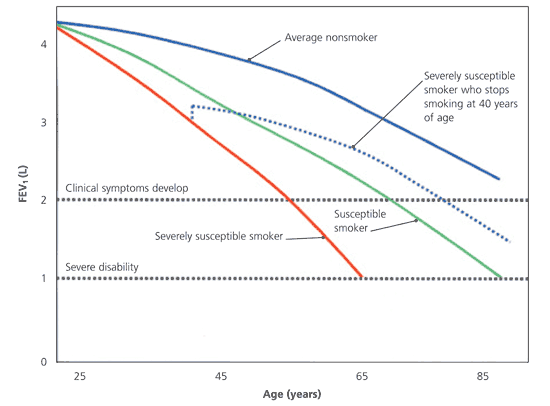
Lung Function Decline in Smokers and Nonsmokers

The natural history of lung function decline. Smokers who are susceptible to lung injury experience an increase in the rate of age-related loss in FEV1 compared with nonsmokers (red, green, and blue lines). After lung function declines to threshold levels, clinical symptoms develop (black dotted lines). When a smoker stops smoking, the rate of FEV1 loss again approximates to that of a nonsmoker (blue dotted line). (FEV1 = forced expiratory volume in one second.)


GOLD Staging System for COPD Severity

StageDescriptionFindings*
0
At risk
Risk factors and chronic symptoms but normal spirometry
I
Mild
FEV1/FVC ratio less than 70 percentFEV1 at least 80 percent of predicted valueMay have symptoms
II
Moderate
FEV1/FVC ratio less than 70 percentFEV1 50 percent to less than 80 percent of predicted valueMay have chronic symptoms
III
Severe
FEV1/FVC ratio less than 70 percent FEV1 30 percent to less than 50 percent of predicted valueMay have chronic symptoms
IV
Very severe
FEV1/FVC ratio less than 70 percentFEV1 less than 30 percent of predicted value
or
FEV1 less than 50 percent of predicted value plus severe chronic symptoms