Showing posts with label cardiovascular. Show all posts

Monday, December 26, 2011

Dabigatran (Pradaxa)for Prevention of Stroke in Atrial Fibrillation

Dabigatran (Pradaxa)is an orally administered direct thrombin inhibitor labeledfor the prevention of stroke and systemic embolism in patients with nonvalvular atrial fibrillation. Unlikewarfarin (Coumadin), it does not induce anticoagulation through depletion of clotting factors, but through an immediate effect on thrombin, the last step in the coagulation cascade that causes clotformation.


DrugDosageDoseformCost of full course [*]
Dabigatran (Pradaxa)150 mg twice daily; 75 mg twice daily in patients with impaired renal function75- and 150-mg capsules$246for 60 150-mg capsules

<><><>
*    —Estimated retail price of one month's treatment based on information obtained at http://www.blogger.com/website/view?area=be&URL=http://www.drugstore.com (accessed October 25, 2010).


Safety Tolerability Effectiveness Price Simplicity


Dabigatran increases the risk of minor and major bleeding. In a randomized controlled trial ofdabigatran compared with dose-adjustedwarfarin (International Normalized Ratio of 2.0 to 3.0) in more than 18,000 patients with atrial fibrillation, life-threatening bleeding and intracranial hemorrhage occurred less often withdabigatran, with one fewer patient experiencing an intracranial hemorrhagefor every 117 patients treated withdabigatran instead ofwarfarin (number needed to treat [NNT] = 117; 95% confidence interval [CI], 82 to 201).[1]Although gastrointestinal bleeding occurs more often withdabigatran, the incidence of minor bleedingis lower (NNT = 37; 95% CI, 23 to 99).[1]Unlikewarfarin,dabigatran lacks significant drug interactions. However, the concurrent use of antiplatelet agents, heparin, or long-term nonsteroidal anti-inflammatory drugs may increase the risk of bleeding. Thereis no reversal agentfordabigatran. Itis renally eliminated, and the dosage must be reduced in patients with a creatinine clearance of less than 30 mL per minute per 1.73 m2 (0.50 mL per second per m2).[2]Dabigatran has not been studied in children or in pregnant or breastfeeding women. Itis a U.S Food and Drug Administration pregnancy category C drug.


In clinical trials, more patients receivingdabigatran withdrew because of adverse effects compared with those receivingwarfarin.Dabigatran causes dyspepsia and gastritis symptoms in about one-third of patients.


Dabigatran has been compared with enoxaparin (Lovenox) andwarfarin in randomized controlled trials. In a study of 18,000 patients with atrial fibrillation, those who receiveddabigatran had significantly fewerischemic strokes than those who receivedwarfarin for a median of two years (NNT = 91; 95% CI, 59 to 194).[1]Dabigatran has been studiedfor surgery prophylaxis (versus enoxaparin) andfor the treatment of deep venous thrombosis and pulmonary embolism (versuswarfarin), but itis not labeledfor these uses


A one-month supply of 150-mgdabigatran capsules costs approximately $246; a one-month supply of genericwarfarin costs approximately $15.[6]The lack of laboratory monitoring or office visitsfor dose titration may partially offset this difference.


Dabigatran produces an effect on coagulation in 30 to 90 minutes, has a predictable response, does not require routine laboratory monitoring, and does not have the drug and food interactions that can be problematic withwarfarin therapy. Patient compliance with twice-daily dosing must be stressed. The dose ofdabigatran is fixed and does not require titration when therapyis initiated or discontinued.

Bottom Line

Dabigatran is superior towarfarin for stroke prevention in patients with atrial fibrillation, with similar rates of major bleeding. Because it does not require laboratory monitoring,dabigatran therapyis less complicated thanwarfarin therapy, but it costs significantly more

Friday, November 18, 2011

valvular diseases questions

When patient with aortic stenosis develops symptoms?
Symptoms do not usually develop until the area is < 1 cm2 (the normal valve area is 3–4 cm2), jet velocity is > 4 m/sec, and the pressure gradient is > 40 mmHg

What is the classical clinical presentation of aortic stenosis?
Clinical Presentation: Exertional dyspnea, ↓ exercise tolerance, angina pectoris, syncope, congestive heart failure, sudden death.

What is management of asymptomatic AS ?

There is no effective pharmacologic therapy for aortic stenosis.
Asymptomatic AS management includes close clinical follow-up to monitor aortic valve area (normal is 3 to 4 cm2).
In addition, patients require endocarditis antibiotic prophylaxis and avoidance of medication that could result in hypotension.
Symptoms occur late in the course of disease and are an ominous sign. Onset of symptoms triggers the need for surgical evaluation


When AVR indicated?

indicated if the patient becomes symptomatic, if there is evidence of left ventricular dysfunction, or if the patient has an expanding poststenotic aortic root

Valve replacement is associated with ↓ symptoms and improved mortality

What is preferable surgery in children and young adults with congenital, noncalcific AS ?

Percutaneous balloon aortic valvuloplasty

What is management of asymptomatic mitral stenosis?

An annual history and physical examination, as well as a chest x-ray and ECG, are recommended in asymptomatic patients. Endocarditis prophylaxis in indicated in patients with MS; however, no further medical therapy is indicated.

When mild symptoms develop, diuretic may be helpful in reducing left atrial pressure and decreasing symptoms.

If symptoms are more than mild or if there is evidence of pulmonary hypertension, mechanical intervention is warranted and delaying intervention worsens prognosis

When surgery is indicated in case of mitral stenosis?

Indicated in symptomatic patients with isolated MS whose valve orifice is <1.7 cm

Enumerate types of mitral stenosis surgeries?

Percutaneous Mitral balloon valvotomy

surgical (“open”) valvotomy

What is mainstay medical treatment of aortic regurgitation?

The mainstays of medical management in symptomatic patients are after load reduction (ACE AND OTHER vasodilator), which reduces the amount of aortic regurgitations. Long-acting nefidipin has been shown to delay the need for valve surgery

When surgery indicated for patient with aortic regurgitation?

Aortic valve replacement should also be performed with progressive left ventricular dysfunction and a left ventricular ejection fraction <55% or left ventricular end-systolic volume >55%—“55/55 Rule” (even if asymptomatic).

WHAT ARE  Valvular Lesions Increasing Maternal and Fetal Risk?
æ Severe AS with or without symptoms
æ MR or AR with NYHA functional Class III to IV symptoms
æ MS with NYHA functional Class II to IV symptoms
æ Valve disease resulting in severe pulmonary hypertension (pulmonary pressure > 75% of systemic pressures)
æ Valve disease with severe left ventricular dysfunction (EF <0.40)
æ Mechanical prosthetic valves requiring anticoagulation
æ AR in Marfan syndrome

Prosthetic valve:

Bioprosthetic valves are preferable to mechanical valves for older patients with a life expectancy of < 10 years and for those who are unable to take long-term anticoagulants.
Anticoagulation
æ Bioprosthetic valves: Give three months of warfarin after placement; then consider aspirin in high-risk patients.
æ Mechanical valves: All patients should be anticoagulated in light of the higher risk of thrombus formation. The target INR depends on the type and location of the valve.

Complications
1. Thrombosis is the most common problem. Risk is ↑ with the mitral valve, AF, previous emboli, left atrial thrombus, and LV dysfunction.
iSummary EBC INTERNAL MEDICINE

æ The highest risk occurs with the mitral valve and inadequate anticoagulation.
æ Can present with heart failure, poor perfusion, and hemodynamic instability.
æ Diagnosed by echocardiogram.
æ Larger thrombi (> 5 mm) require fibrinolysis or valve replacement.
æ Heparin may be used with smaller thrombi.

2. Endocarditis:
æ With invasive procedures, patients should receive antibiotic prophylaxis.
æ Early: Occurs during the first 60 days after placement. Often fulminant with high mortality.
æ Late: A higher risk is associated with multiple valves or bioprosthetic valves.

3. Other problems include hemolysis, perivalvular leak, valve failure, and dysrhythmias
 

Saturday, November 5, 2011

Answers of the questions

1-What is treatment of systolic heart failure stage A?


Individuals with stage A should be treated with therapies that can delay progression of cardiac dysfunction and development of heart failure. 

Optimizing hypertension treatment based on the current (JNC VII) can reduce new-onset heart failure by 50%. Therapies such as diuretics, β-blockers, angiotensin-converting enzyme inhibitors (ACEIs), and angiotensin II receptor blockers (ARBs) are proven to be more effective than calcium channel blockers and doxazosin in preventing heart failure.

Use of statin therapy in CAD patients based on current hyperlipidemia guidelines [ATP III] can also reduce the incidence of heart failure by 20%. 

Evidence-based disease management strategies for atherosclerotic vascular disease, and thyroid disease, as well as patient avoidance of tobacco, alcohol, cocaine, amphetamines, and other illicit drugs that can be cardiotoxic, are also important components of early risk modification for prevention of heart failure. 

In diabetic patients, both ACEIs and ARBs (specifically losartan and irbesartan) have been shown to reduce new-onset heart failure compared with placebo.

In CAD or atherosclerotic vascular disease patients without heart failure, reviews of the EUROPA and HOPE Trials results show a 23% reduction in heart failure with ACEI therapy as well as reduced mortality, MIs, and cardiac arrest.


What is treatment of systolic heart failure stage B?

Patients who do not have clinical symptoms of heart failure but who have a structurally abnormal heart, such as a previous MI, evidence of left ventricular remodeling (left ventricular hypertrophy or low ejection fraction), or valvular disease, are at a substantial risk of developing symptomatic heart failure. 

Prevention of further progression in these at-risk patients is the goal, and appropriate therapies are dependent on the patient's cardiac condition

In all patients with a recent or remote history of MI, regardless of ejection fraction, ACEIs and β-blockers are the mainstay of therapy. Both therapies have been demonstrated in randomized control trials to cause a significant reduction in cardiovascular death and heart failure.

There is no clear evidence for use of ARBs in asymptomatic patients with reduced left ventricular ejection fraction; however, ARB therapy is a reasonable alternative in ACEI-intolerant patients.

What is standard  treatment of symptomatic systolic heart failure (stage c)?

The overall goals in this stage are to improve the patient's symptoms, slow or reverse the deterioration of cardiac functioning, and reduce the patient's long-term morbidity and mortality.

Accurate assessment of the cause and severity of heart failure, the incorporation of previous stage A and B treatment recommendations, and correction of any cardiovascular, systemic, and behavioral factors are important to achieve control in patients with symptomatic heart failure. 

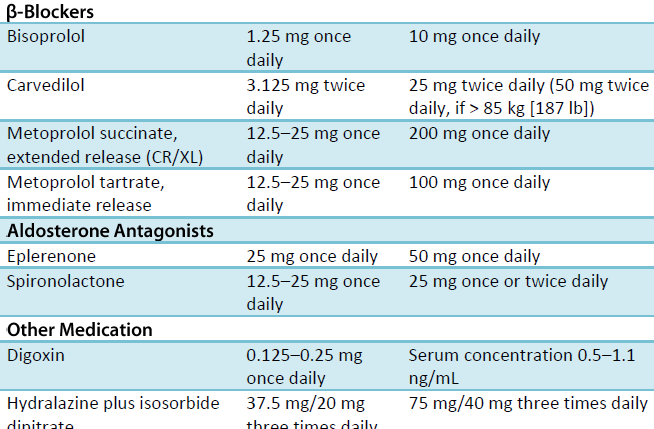
Patients with symptomatic heart failure should be routinely managed with a standard therapy of a diuretic, an ACEI (or ARB if intolerant), and a β-blocker. The addition of other pharmacologic therapies should be guided by the need for further symptom control versus the desire to enhance survival and long-term prognosis. A stepwise approach to therapy is presented in next table and expanded upon below.